
Last updated: November 05, 2026
Key Takeaways
- Older adults need enough fluid for circulation, kidneys, temperature control, and thinking.
- Dehydration can start quietly and worsen fast in older adults.
- Missed dehydration usually has practical causes.
- For most older adults, water is the easiest default drink.
Older adults often need a simpler plan, not a more complicated one: drink enough fluid daily, watch for dehydration signs that are easy to miss, and adjust for medications, illness, heat, and mobility limits. This guide on Hydration basics for older adults — The Complete Guide gives a practical starting point. I write about senior health and practical prevention topics, and hydration is one of the few issues where small changes can prevent a lot of trouble.
What hydration means after age 65

Hydration means keeping enough fluid in the body for blood flow, kidney function, temperature control, and normal thinking. For an older adult, that is not just “drink water when thirsty.” Thirst becomes less reliable with age, and the body may hold less water than it did at 40 or 50.
A plain target can work better than a rigid rule: drink regularly through the day and use your body’s signals as a backup, not as the only cue. The National Academies of Sciences, Engineering, and Medicine sets Adequate Intake levels for total water at about 3.7 liters a day for men and 2.7 liters a day for women from all beverages and food combined; that is a general benchmark, not a prescription for every person. Older adults with heart failure, kidney disease, or fluid restriction from a clinician should not use that number as a personal goal without medical advice. The same caution applies to any plan that ignores medical limits.
The reason this matters is simple. Dehydration can show up as confusion, constipation, dizziness, falls, a dry mouth, darker urine, or sudden weakness. In an older adult, those signs can be mistaken for “just getting old,” which delays care.
A hydration plan for this age group often has three parts:
- drink on a schedule
- choose fluids that are easy to swallow and easy to remember
- know when fluid needs change because of heat, fever, diarrhea, vomiting, or medication
The plan does not need special products. It does need attention, especially when appetite and thirst fade together.
How much fluid do older adults really need?
The right amount is usually enough to keep urine pale yellow, keep energy and thinking steady, and prevent constipation, but not so much that it worsens swelling or shortness of breath in someone with a fluid limit. That sounds vague because the answer genuinely depends on health conditions, body size, medicines, and climate.
For many healthy older adults, a practical daily range is several cups spread across the day, with extra on hot days or with exercise. A cup of fluid at breakfast, lunch, dinner, and between meals is a strong starting point. That is not a perfect formula, but it is easier to follow than waiting to feel thirsty.
The main mistake is assuming every beverage counts equally in the same way for every person. Coffee, tea, milk, broth, juice, and water all add fluid. Alcohol is different because it can promote dehydration and also increase fall risk. For someone who has trouble eating enough, soups, smoothies, milk, or oral rehydration solutions may be more useful than plain water alone.
There is also a difference between drinking enough and drinking at the right times. If most fluid comes late at night, the person may wake repeatedly to urinate and then drink less the next day because they are tired. If most fluid comes only at meals, long stretches between meals can still leave the body underfueled.
The honest bottom line: a healthy older adult should usually drink steadily through the day rather than chase one exact number. A person with chronic kidney disease, heart failure, liver disease, or prescribed fluid restriction needs an individualized target from a clinician, because “more” is not automatically safer.
Signs of dehydration older adults should not ignore
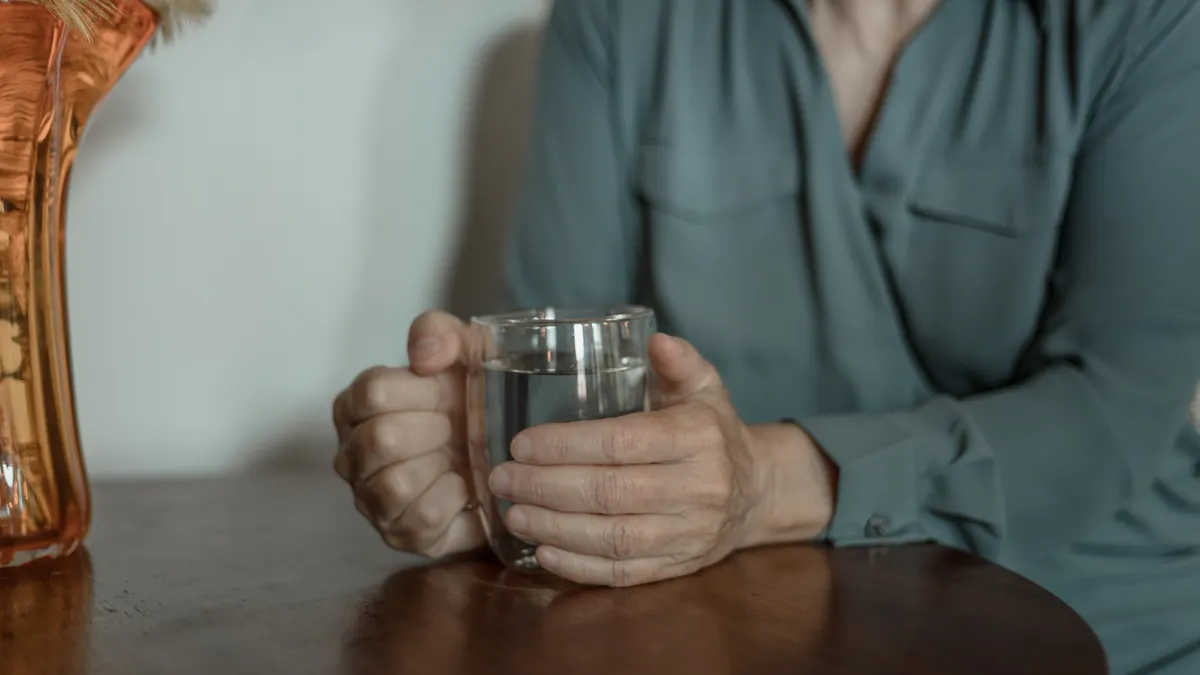
Dehydration in older adults is often subtle first and dramatic later. Mild symptoms can look like forgetfulness, irritability, constipation, headache, dry lips, reduced urine output, or feeling off balance. Those clues matter more than thirst, which may be weak or delayed.
The clearest red flags are confusion, marked sleepiness, fainting, rapid heartbeat, very dark urine, very little urine, or inability to keep fluids down because of vomiting or diarrhea. If an older adult becomes suddenly more confused, that should not be written off as a normal age change. It deserves prompt medical attention, especially if it happens with fever, a urinary infection, or a heat wave.
Urine color helps, but it is not perfect. Pale yellow usually suggests adequate hydration. Very dark urine can suggest dehydration, but some vitamins and medicines also change urine color. A person taking a diuretic may urinate often and still be dehydrated if intake is too low.
Because the picture is often mixed, there are also less obvious clues:
- dry mouth and cracked lips
- constipation that is new or worse than usual
- dizziness when standing
- muscle cramps
- reduced appetite
- fatigue that seems out of proportion
One practical rule: when mental status changes, balance changes, or urine output drops together, treat hydration as a serious possibility, not a small comfort issue. That is especially true in older adults living alone, because no one may notice the decline until a fall or a hospitalization forces the issue.
Why older adults miss dehydration
Older adults miss dehydration for reasons that are practical, not mysterious. Thirst weakens with age. Mobility problems make the bathroom feel far away. Incontinence makes people intentionally drink less. Some avoid fluids because they do not want to wake up at night. Others simply forget.
Medication adds another layer. Diuretics, laxatives, some blood pressure drugs, and medicines that cause dry mouth can all push fluid balance in the wrong direction. That does not mean these medicines are bad; it means hydration has to be planned around them. A person taking a diuretic in the morning may need to drink more earlier in the day, not all at night.
Cognitive decline can make the problem even harder. Someone with mild dementia may not remember to drink or may not recognize the cue. In that case, hydration should be built into routines: one glass with each meal, one mid-morning, one mid-afternoon, and one with medicine if allowed.
Heat is another common trigger. Older adults may feel less bothered by warmth than younger people, but the body still loses fluid through sweat and breathing. During heat waves, fans and cool rooms help, but they do not replace fluid intake.
The useful takeaway is not “drink more” in the abstract. It is “remove the barriers.” Put water where the person sits. Use a light cup if grip is weak. Offer fluids at the same times every day. Make the bathroom path safe enough that drinking less is not the only self-protection strategy, and pair that with lighting and clear walkways.
The Best Drinks for Older Adults
For most older adults, water wins because it is cheap, easy to tolerate, and does not bring sugar, caffeine, or sodium with it. That said, water is not the only good choice, and it is not always the best choice for every situation.
Plain water is the default for daily use. It is especially useful between meals, after waking, and in warm weather. If plain water feels boring, chilled water, water with lemon, or water served in a favorite cup can make the habit easier to keep.
Milk can help when someone needs fluid plus calories and protein. Broth and soups work well when appetite is low. Herbal teas can be fine if they are noncaffeinated. Fruit-heavy smoothies can help someone who struggles to chew, but the sugar load can be high if juice or sweeteners are added freely.
Oral rehydration solutions matter when fluid loss is more than ordinary, such as with diarrhea, vomiting, or fever. They replace water plus electrolytes in a way plain water cannot match in those settings. For regular day-to-day use, they are usually unnecessary unless a clinician recommends them.
The weaker choices are easy to name:
- alcohol, because it can worsen dehydration and increase falls
- energy drinks, because caffeine and stimulants can be unhelpful in older adults
- very sugary drinks, because they can aggravate blood sugar problems
- large amounts of caffeinated beverages late in the day, because sleep and nighttime bathroom trips become a problem
The right drink is the one the person will actually consume safely. A dehydration plan that relies on a pitcher of water nobody touches is a plan that fails.
How to make hydration easier at home
The easiest home hydration plan is the one attached to habits already in place. Drink when taking medications, at each meal, and during regular pauses in the day. A schedule beats memory almost every time.
A simple routine can look like this:
- one drink on waking
- one with breakfast
- one mid-morning
- one with lunch
- one mid-afternoon
- one with dinner
- one small drink if allowed with evening medicine
That is not a law. It is a scaffold. For some people, 6 to 8 small drinks works better than 2 large ones. Small amounts are kinder for those with early fullness, reflux, swallowing trouble, or bladder urgency.
The home setup matters too. A heavy glass may be a barrier. A cup with a handle, a spill-resistant lid, or a straw may make drinking easier. If hands shake, use containers that are stable and easy to grip. If the person cannot remember to drink, leave the cup in the same visible place each day.
Food counts as well. Soup, melon, oranges, yogurt, and many cooked vegetables contribute fluid. For an older adult who eats little, that matters. Food with water content can do part of the job when drinking is hard.
The main drawback of a home routine is that it can be thrown off by bathroom concerns. If nocturia or urgency is the reason fluid is being avoided, the answer is not usually to cut drinks all day. It is better to review the timing of fluids, medications, caffeine, and bladder habits with a clinician.
What changes hydration needs the most?
Illness, heat, and medications change hydration needs faster than age alone does. A mild stomach virus can turn a stable routine into a medical problem in one day. Fever, diarrhea, and vomiting increase fluid losses and can also make the person less willing to drink.
Heat is another major shift. On very hot or humid days, older adults may need more fluids even if they are not sweating much. Indoor cooling matters, but it does not remove the need to drink.
Medications deserve special attention. Diuretics increase urine loss by design. Some antidepressants, blood pressure medicines, and other drugs can affect thirst, blood pressure, or sodium balance. The safest move is not to guess; it is to ask a pharmacist or clinician whether any medicine changes hydration risk.
Swallowing problems change the equation too. If a person coughs, chokes, or “gurgles” with thin liquids, plain water may be unsafe without guidance. That needs medical assessment, because aspiration can lead to pneumonia. In that case, thickened liquids or swallowing therapy may be more appropriate than simply urging more water.
A final change is functional, not medical: after a fall, infection, surgery, or hospital stay, an older adult often needs a temporary hydration plan, not the old routine. Recovery phases commonly require more watching, not less.
When dehydration needs medical help
Dehydration needs medical help when the person has confusion, fainting, severe weakness, inability to keep fluids down, very little urine, or signs of shock such as cold skin and a fast pulse. It also needs help when the older adult is already medically fragile.
Seek prompt care if any of the following are present:
- sudden confusion or unusual drowsiness
- repeated vomiting or diarrhea
- fever with poor fluid intake
- a fall linked to dizziness
- chest pain, trouble breathing, or severe weakness
- no urine or very little urine over many hours
If the person has kidney disease, heart failure, diabetes, or takes multiple medicines, the threshold for calling a clinician should be lower. Dehydration can worsen blood pressure, kidney function, and blood sugar control quickly. It can also interact badly with diuretics and some pain medicines.
Do not try to manage severe dehydration only with “drink more water” at home if the person cannot swallow, is vomiting, or is becoming confused. That is the wrong situation for patience.
At the same time, not every dry mouth means emergency care. A dry mouth from mouth breathing, medication, or a warm room may improve with small sips, a humidifier, or sugar-free lozenges. The key is to look at the whole picture, not one symptom in isolation.
What should caregivers and family watch for?
Caregivers should watch for pattern changes more than single complaints. If an older adult suddenly drinks less, urinates less, skips meals, or becomes more unsteady, hydration may be part of the problem even before obvious dehydration appears.
The most useful caregiver job is to make drinking automatic. Keep a bottle or cup in sight, refill it at set times, and pair fluids with daily routines such as morning pills, a television program, or a walk. If the person has memory problems, do not wait for them to ask for a drink.
Caregivers should also track the trade-off between hydration and bathroom burden. Some older adults drink less because they fear falls on the way to the toilet, especially at night. In that case, a bedside commode, night lighting, a clear path, or a medication review may do more good than simply telling the person to drink more.
Watch for these specific changes:
- new constipation
- dark urine
- stronger odor in the urine
- dizziness when standing
- lower appetite
- dry skin and mouth
- sudden fatigue
If the person has swallowing trouble, repeated coughing with drinks, or a history of stroke, ask for swallowing evaluation instead of guessing at liquids. A silent aspiration risk can be more dangerous than ordinary dehydration.
Caregivers do not need to turn hydration into a contest. They need to remove friction, notice change early, and call for help when the pattern points away from simple self-care.
The real trade-offs in hydration choices
The best hydration plan is not the one with the most fluid. It is the one that fits the person’s health limits, bathroom access, memory, and daily routine. That is why a one-size-fits-all answer fails here.
Plain water is the safest default, but it may not be enough if the person has poor appetite or diarrhea. Sports drinks are not automatically better; they may add sugar and sodium that are unnecessary for most older adults. Caffeinated drinks can help some people drink more because they enjoy them, but too much caffeine can worsen sleep and urgency. Thickened liquids can protect swallowing safety for some people, but they can also reduce intake because many people dislike the texture.
The least useful advice is “just drink when you feel thirsty.” That works better in younger adults with intact thirst, stable mobility, and no major illnesses. It is weaker advice for a 79-year-old on a diuretic who lives alone and forgets to drink until evening.
My position is straightforward: for most older adults, a regular fluid routine built around water and other tolerated beverages is the best choice. It is wrong for someone with fluid restriction, severe swallowing trouble, or active vomiting, where medical guidance matters more than habit.
The simple verdict for daily use
Choose a steady, scheduled fluid routine if the older adult is generally healthy, forgets to drink, or avoids fluids because of habit or fear of bathroom trips. Choose a medically guided fluid plan if there is heart failure, kidney disease, severe swelling, swallowing trouble, or repeated dehydration. Neither approach should rely on thirst alone if confusion, falls, or illness are already showing up.
The clearest rule is also the least glamorous one: drink little and often, use the bathroom concerns as part of the plan, and treat sudden changes in thinking, balance, or urine as warning signs. That is the real foundation of Hydration basics for older adults: a complete guide.
What to do next if hydration keeps slipping
If hydration keeps slipping, the fix is usually not a new “super drink.” It is a system change. Review medicines with a pharmacist or clinician, simplify the cup and bottle setup, and build fluid into existing habits. If the person coughs with drinks, gets frequent urinary problems, or becomes confused often, ask for a medical evaluation rather than trying to solve it with willpower.
For reliable public guidance, the National Institute on Aging and the Centers for Disease Control and Prevention both publish practical material on older-adult hydration and heat-related illness. The National Academies’ water intake reference is also useful as a general benchmark, as long as it is not treated as a personal prescription.
Drafted with AI; not yet reviewed by a person.

Leave a Reply